Okay, while I'm asking questions I sort of know the answers to...here's one that's been rolling around in my head for a bit.
On the three big network nightly news shows, there are two new anchors who came to prominence in this country on morning shows. One is Katie Couric. Perhaps you haven't heard, but she is now anchoring the CBS Evening News. Just kidding. Of course you've heard, because it was a fascinating topic for newspapers, entertainment news shows, and even political cartoonists, for months. The general consensus seemed to be that Katie lacked the credentials to be a serious nightly news anchor, because she was on The Today Show, which does more fluffy stories than a nightly news show.
The other new anchor is Charlie Gibson, who comes to the ABC's World New Tonight from Good Morning America. Perhaps I missed it, but I haven't seen one story, or cartoon for that matter, suggesting that this transition is troubling in the least.
Granted, Charlie Gibson has probably never been described as "perky," the favorite adjective attached to Katie Couric. But it seems like there has to be more at play here. Good Morning America is just as fluffy as The Today Show, so what's the deal? Could it be simply that we don't want a woman--especially a perky one--sitting in the chair once occupied by Walter Cronkite and Dan Rather?
That doesn't seem quite fair. Maybe I'm just being sensitive. I can be sensitive. I'm a woman after all.
Thursday, September 28, 2006


Tuesday, September 26, 2006
The Hillary Pillory
I'm a little confused, and wonder if others are too. Once again, the source of my confusion is The Rev. Jerry Falwell.
This week's Falwell Folly is a statement made at the Values Voter Summit, a gathering of conservative pastors and church leaders. He was talking about the 2008 presidential election. Here's the LA Times account:
"I certainly hope that Hillary is the candidate," Falwell said, according to the recording. "She has $300 million so far. But I hope she's the candidate. Because nothing will energize my [constituency] like Hillary Clinton."
Cheers and laughter filled the room as Falwell continued: "If Lucifer ran, he wouldn't."
According to Falwell and Tony Perkins from the Family Research Council, the Lucifer comment was meant to be humorous. I would submit that whether he intends it that way or not, a lot of what Jerry Falwell says is humorous. But it's an uncomfortable humor, the sort one hears privately from folks discussing Hugo Chavez' speech at the UN last week. A sort of chuckle-groan.
I'd ignore this comment, as part of my spiritual discipline of not wasting brain cells considering inflammatory, quasi-religious nonsense. But he's not the only one expressing this sentiment. (Though so far he's the only one to privilege the Clinton candidacy above the as-yet-unnanounced Party of Satan on the evangelical motivator scale.)
So here's where I'm confused. There are a lot of people contemplating runs for the White House in 2008. Some of them are staunchly in favor of abortion rights, gay marriage, and universal health care. Some of them are staunchly opposed to the Iraq war, and favor at the least a timetable for withdrawal of our troops.
It would seem as if "'Values' Voters" (whatever that means) would be more motivated by one of these candidates. And Hillary Clinton isn't one of these candidates. She's been pretty moderate in the Senate, ostensibly for the purpose of representing her New York constituents, which is what she was elected to do. It's hard to imagine her moving to the left in a presidential run, since the country as a whole isn't exactly left of New York State.
So what is it about Hillary Clinton that will so motivate evangelical voters? It can't be her voting record. Her Traditional Marriage street cred is pretty good: she's against gay marriage, and has demonstrated remarkable commitment to a philandering husband. I still love Bill Clinton, but it's fair to say a lot of women would have divorced his charming derriere. She continues to support the war (if not Donald Rumsfeld), and to speak out against the withdrawal of troops. She would still like health care coverage for all Americans, but has backed way off of a comprehensive plan like the one which never got out of the starting gate in 1993.
The truth is, Hillary Clinton has disappointed those who thought that she would be a true progressive in the Senate.
So what is it about her that would, according to Jerry Falwell and some more highly respected pundits, send conservatives to the polls in droves? I guess the devil is in the details.
This week's Falwell Folly is a statement made at the Values Voter Summit, a gathering of conservative pastors and church leaders. He was talking about the 2008 presidential election. Here's the LA Times account:
"I certainly hope that Hillary is the candidate," Falwell said, according to the recording. "She has $300 million so far. But I hope she's the candidate. Because nothing will energize my [constituency] like Hillary Clinton."
Cheers and laughter filled the room as Falwell continued: "If Lucifer ran, he wouldn't."
According to Falwell and Tony Perkins from the Family Research Council, the Lucifer comment was meant to be humorous. I would submit that whether he intends it that way or not, a lot of what Jerry Falwell says is humorous. But it's an uncomfortable humor, the sort one hears privately from folks discussing Hugo Chavez' speech at the UN last week. A sort of chuckle-groan.
I'd ignore this comment, as part of my spiritual discipline of not wasting brain cells considering inflammatory, quasi-religious nonsense. But he's not the only one expressing this sentiment. (Though so far he's the only one to privilege the Clinton candidacy above the as-yet-unnanounced Party of Satan on the evangelical motivator scale.)
So here's where I'm confused. There are a lot of people contemplating runs for the White House in 2008. Some of them are staunchly in favor of abortion rights, gay marriage, and universal health care. Some of them are staunchly opposed to the Iraq war, and favor at the least a timetable for withdrawal of our troops.
It would seem as if "'Values' Voters" (whatever that means) would be more motivated by one of these candidates. And Hillary Clinton isn't one of these candidates. She's been pretty moderate in the Senate, ostensibly for the purpose of representing her New York constituents, which is what she was elected to do. It's hard to imagine her moving to the left in a presidential run, since the country as a whole isn't exactly left of New York State.
So what is it about Hillary Clinton that will so motivate evangelical voters? It can't be her voting record. Her Traditional Marriage street cred is pretty good: she's against gay marriage, and has demonstrated remarkable commitment to a philandering husband. I still love Bill Clinton, but it's fair to say a lot of women would have divorced his charming derriere. She continues to support the war (if not Donald Rumsfeld), and to speak out against the withdrawal of troops. She would still like health care coverage for all Americans, but has backed way off of a comprehensive plan like the one which never got out of the starting gate in 1993.
The truth is, Hillary Clinton has disappointed those who thought that she would be a true progressive in the Senate.
So what is it about her that would, according to Jerry Falwell and some more highly respected pundits, send conservatives to the polls in droves? I guess the devil is in the details.
Monday, September 25, 2006
Ten Things Which Are Wonderful
- Having a day off
- My wife's cooking
- Being greeted by the dogs which love you unconditionally
- Preaching to people who are actively listening
- NPR
- Football season
- Freshly cut grass
- Laser printers
- A sunny Fall day
- Office supply stores
Yes, I'm feeling very blessed today. What ten things are you thankful for in this moment?
Friday, September 22, 2006
Why I Don't Title My Sermons
Ever since I was a seminary student, preaching quarterly at my "teaching parishes," I've avoided titling my sermons. I had to do it for a church I preached at twice while on internship--they were insistent. I think it's fine if people want to do it, but I'm part of the generation of preachers trained in more inductive methods, and sermon titles seem to work at cross purposes to inductive preaching. You don't tell 'em what you're going to tell 'em until you've told 'em.
This morning's Kansas City Star offers some reinforcement for this decision. As many of you likely have, I've been watching with interest the unfolding story of All Saints Episcopal Church in Pasadena, California, which is under IRS scrutiny for what has been described as an "anti-war, anti-poverty" sermon preached two days before the 2004 election. The IRS is considering revoking All Saints' tax exempt status, for "implicit endorsement."
There are numerous troubling details in this case. First, the sermon was preached by a guest preacher, not someone on staff at All Saints. That may or may not be relevant. Allowing someone the pulpit does imply a certain level of endorsement of the message, inasmuch as you can know what the message will be. Second, by all previous accounts, the preacher spoke about issues which should be important to voters, but specifically refrained from endorsing a candidate or a party. Those are the lines one cannot cross--you can't endorse a candidate or a party. The tax code is unspecific on talking about war or poverty. Indeed, I'd hope it would be difficult to preach if these subjects were off the table.
*Okay, I have to tell this only-semi-related story: I was at an event last night called "Walking the Talk of Welcome," sponsored by a group with which I'm involved here in KC. The former moderator of a local UCC church was speaking about the process their church went through to become Open and Affirming. She talked about the effects of their decision, noting that a few people had left during the process, but only one had left after the vote to become ONA (yes, really, that's how it's abbreviated). The former moderator didn't think, however, that the person left because of the vote, because he or she, upon leaving, declared "We just keep talking all the time about the poor." Egads.
Back to the matter at hand. I've been firmly on the side of All Saints, and certain that they were getting railroaded. I'm still on their side, but I did gasp just a little upon reading in today's Kansas City Star that the title of the precipitating sermon was "If Jesus Debated Senator Kerry and President Bush." Specifically stated in the sermon was the (surely true) opinion of the preacher that Jesus would be firmly against the Iraq war and President Bush's doctrine of pre-emptive war.
I would love to hear how others receive this information. Did the preacher go too far? Where is the "endorsement line?" What is kosher, if you will, and what is not?
This is a very complicated situation, and there are no easy answers. The preacher was apparently critical of both candidates, but I'm just not sure I would have named them in a sermon title. This is a moot point, of course, since I don't do sermon titles. If I did do sermon titles, though, I hope I would consider the human tendency toward binary thinking and the proximity of the election, and not use the words "Kerry," "Bush," and "debate" in my sermon title. It just seems like you're setting them up to hear you endorse someone, and even if you want that someone to be Jesus, some will take away a different message.
I do preach political sermons. I preached about the war, and continue to do so. I know I cross lines that many of my colleagues would never cross. But I think preaching is essentially the practice of placing scripture in the context of our lives, and I don't know how to do that without crossing over into subjects that can be considered political. It seems to me that Jesus talked a lot about subjects which cross over into the political. Questions of wealth and poverty, discrimination and inclusion, power and powerlessness are at their essence political questions. I'm not sure how to preach to the context of my congregation without addressing these things.
The situation with All Saints is also, quite clearly, a political one. There is a line which cannot be crossed, and it is possible that All Saints crossed it. I don't happen to think so, but that's obviously debatable. But the politics in this go beyond the situation at hand.
I'd like to hear a little debate on the role conservative churches play in electing candidates, and why All Saints is under scrutiny while they apparently are not. It would appear that the mistake All Saints made was not blowing with the right wind.
Recently someone leaked a memo from Kansas Attorney General Phill Kline, who is running for re-election. The subject line of the four page email was "church efforts," and it contained instructions from Kline to his staff on how to "get him into pulpits" and raise money at as many churches as possible between now and election day.
I'm not putting too fine a point on it. Here are a couple of quotes from the memo:
"Get the pastor to invite 5 'money people,' whom he knows can help."
"Goal is to walk away with contact information, money and volunteers and a committee in each church."
The plan is to have Kline preach, then get the "money people" to host receptions, off of church property, to raise money.
Perhaps the off-site fundraisers get these churches and pastors off the hook. I know that we would draw the line at inviting a candidate to preach who was running for election. As I've already said, allowing someone the pulpit does constitute an implicit endorsement. I can't even imagine the prospect of helping the candidate "walk away with contact information, money and volunteers, and a committee" in our church. . Apparently the IRS has a different opinion, because I haven't heard that they were going to be investigating any of the churches implicated in this memo. And there were specific churches implicated. More churches will be implicated as this strategy comes to fruition.
It's messy business, the mixing of religion and politics. There are a lot of things I would like to say in the pulpit which I feel I cannot say. There are things I feel I should say, things I think Jesus would say, which I do not say in the pulpit. And there are a lot of things I have the freedom to say because I'm in a really great congregation which allows me more of that freedom than many would.
Ultimately, we have to do our best to be true to the gospel and keep out of trouble with the government. And that may be easier said than done.
This morning's Kansas City Star offers some reinforcement for this decision. As many of you likely have, I've been watching with interest the unfolding story of All Saints Episcopal Church in Pasadena, California, which is under IRS scrutiny for what has been described as an "anti-war, anti-poverty" sermon preached two days before the 2004 election. The IRS is considering revoking All Saints' tax exempt status, for "implicit endorsement."
There are numerous troubling details in this case. First, the sermon was preached by a guest preacher, not someone on staff at All Saints. That may or may not be relevant. Allowing someone the pulpit does imply a certain level of endorsement of the message, inasmuch as you can know what the message will be. Second, by all previous accounts, the preacher spoke about issues which should be important to voters, but specifically refrained from endorsing a candidate or a party. Those are the lines one cannot cross--you can't endorse a candidate or a party. The tax code is unspecific on talking about war or poverty. Indeed, I'd hope it would be difficult to preach if these subjects were off the table.
*Okay, I have to tell this only-semi-related story: I was at an event last night called "Walking the Talk of Welcome," sponsored by a group with which I'm involved here in KC. The former moderator of a local UCC church was speaking about the process their church went through to become Open and Affirming. She talked about the effects of their decision, noting that a few people had left during the process, but only one had left after the vote to become ONA (yes, really, that's how it's abbreviated). The former moderator didn't think, however, that the person left because of the vote, because he or she, upon leaving, declared "We just keep talking all the time about the poor." Egads.
Back to the matter at hand. I've been firmly on the side of All Saints, and certain that they were getting railroaded. I'm still on their side, but I did gasp just a little upon reading in today's Kansas City Star that the title of the precipitating sermon was "If Jesus Debated Senator Kerry and President Bush." Specifically stated in the sermon was the (surely true) opinion of the preacher that Jesus would be firmly against the Iraq war and President Bush's doctrine of pre-emptive war.
I would love to hear how others receive this information. Did the preacher go too far? Where is the "endorsement line?" What is kosher, if you will, and what is not?
This is a very complicated situation, and there are no easy answers. The preacher was apparently critical of both candidates, but I'm just not sure I would have named them in a sermon title. This is a moot point, of course, since I don't do sermon titles. If I did do sermon titles, though, I hope I would consider the human tendency toward binary thinking and the proximity of the election, and not use the words "Kerry," "Bush," and "debate" in my sermon title. It just seems like you're setting them up to hear you endorse someone, and even if you want that someone to be Jesus, some will take away a different message.
I do preach political sermons. I preached about the war, and continue to do so. I know I cross lines that many of my colleagues would never cross. But I think preaching is essentially the practice of placing scripture in the context of our lives, and I don't know how to do that without crossing over into subjects that can be considered political. It seems to me that Jesus talked a lot about subjects which cross over into the political. Questions of wealth and poverty, discrimination and inclusion, power and powerlessness are at their essence political questions. I'm not sure how to preach to the context of my congregation without addressing these things.
The situation with All Saints is also, quite clearly, a political one. There is a line which cannot be crossed, and it is possible that All Saints crossed it. I don't happen to think so, but that's obviously debatable. But the politics in this go beyond the situation at hand.
I'd like to hear a little debate on the role conservative churches play in electing candidates, and why All Saints is under scrutiny while they apparently are not. It would appear that the mistake All Saints made was not blowing with the right wind.
Recently someone leaked a memo from Kansas Attorney General Phill Kline, who is running for re-election. The subject line of the four page email was "church efforts," and it contained instructions from Kline to his staff on how to "get him into pulpits" and raise money at as many churches as possible between now and election day.
I'm not putting too fine a point on it. Here are a couple of quotes from the memo:
"Get the pastor to invite 5 'money people,' whom he knows can help."
"Goal is to walk away with contact information, money and volunteers and a committee in each church."
The plan is to have Kline preach, then get the "money people" to host receptions, off of church property, to raise money.
Perhaps the off-site fundraisers get these churches and pastors off the hook. I know that we would draw the line at inviting a candidate to preach who was running for election. As I've already said, allowing someone the pulpit does constitute an implicit endorsement. I can't even imagine the prospect of helping the candidate "walk away with contact information, money and volunteers, and a committee" in our church. . Apparently the IRS has a different opinion, because I haven't heard that they were going to be investigating any of the churches implicated in this memo. And there were specific churches implicated. More churches will be implicated as this strategy comes to fruition.
It's messy business, the mixing of religion and politics. There are a lot of things I would like to say in the pulpit which I feel I cannot say. There are things I feel I should say, things I think Jesus would say, which I do not say in the pulpit. And there are a lot of things I have the freedom to say because I'm in a really great congregation which allows me more of that freedom than many would.
Ultimately, we have to do our best to be true to the gospel and keep out of trouble with the government. And that may be easier said than done.
Tuesday, September 19, 2006
Today's chuckler from The Onion
The links in the story text don't work. Sorry about that. You really don't need them, but you can always get to The Onion by going to www.theonion.com.
New Bill Would Defend Marriage From Sharks
WASHINGTON, DC—Congressional Republicans cited the saw-edged teeth of the shark community as a direct threat to married couples everywhere.
READ MORE
New Bill Would Defend Marriage From Sharks
WASHINGTON, DC—Congressional Republicans cited the saw-edged teeth of the shark community as a direct threat to married couples everywhere.
READ MORE
Community!
My friend Polly sent out an email recently inviting us to check out RevGalBlogPals. There's a box in the left margin of this blog so you can check it out, too. Or you can just click here. I'd recommend it. There you'll find a wonderful community of women in ministry. One could spend quite a bit of time reading the blog, and navigating around in the links to all of the other blogs. One shouldn't, of course, because one has work to do. But one could...
Tuesday, September 12, 2006
Size Matters?
Okay, so maybe I just don't get it, the whole size thing.
[Pause for snickering.]
I'm the pastor of a small congregation. That is the plain truth. I keep thinking (and being told) that I need to find a different adjective. Like...? "Diminutive?" "Cozy?"
We're small. We worship 16-22 people on an average week. We want to have more folks. We know we need to grow. We're committed to mission in the name of Jesus Christ. And we are growing--slowly, but it's happening.
For the time being, though, we're small. What is stunning, and wonderful, is that we're still here. This congregation has gone through a lot. I view the "family" metaphor for church with a hermeneutic of suspicion, but this congregation has endured more than some families which crack apart. They have weathered some pretty troublesome members. They decided to sell the only church building they've ever had in order to continue the mission of the congregation in a more conducive setting. They called a lesbian pastor and waited to see if they would be kicked out of the only denomination they've ever known.
And they are still here. Better than that, they are thriving! The Word of God is proclaimed in our midst, in word and deed. The community which gathers--twice a week, at least--is strong and loving. This is a congregation of folks who really understand ministry, and who are truly focused on the heart of the gospel: love of God and love of neighbor.
But it seems as if every conversation I have with someone who wants to know how we're doing goes like this:
Concerned Person: "So, how is Abiding Peace doing?"
Me: "We're great. The community is really healthy; we're moving forward in the new location; things are going really well."
Concerned Person: "How many people in worship?"
The conversation ends shortly after I offer our latest attendance figures. It seems as if nothing I say matters, if we're not worshipping at least fifty or a hundred or a hundred and fifty or whatever the current "must have" number is for Sunday worship.
I understand this; I really do. Inertia is a dangerous thing in ministry, and low numbers can be indicative of mission drain.
They can also be the beginning of a great success story. The story of Abiding Peace Lutheran Church isn't finished yet. It's going to be great, too. So it would be nice if people could just take a breath and wait for the next chapter, which, I promise, is coming. We're just deep in the creative process. Get the Pulitzers ready.
I'm the pastor of a small congregation. That is the plain truth. I keep thinking (and being told) that I need to find a different adjective. Like...? "Diminutive?" "Cozy?"
We're small. We worship 16-22 people on an average week. We want to have more folks. We know we need to grow. We're committed to mission in the name of Jesus Christ. And we are growing--slowly, but it's happening.
For the time being, though, we're small. What is stunning, and wonderful, is that we're still here. This congregation has gone through a lot. I view the "family" metaphor for church with a hermeneutic of suspicion, but this congregation has endured more than some families which crack apart. They have weathered some pretty troublesome members. They decided to sell the only church building they've ever had in order to continue the mission of the congregation in a more conducive setting. They called a lesbian pastor and waited to see if they would be kicked out of the only denomination they've ever known.
And they are still here. Better than that, they are thriving! The Word of God is proclaimed in our midst, in word and deed. The community which gathers--twice a week, at least--is strong and loving. This is a congregation of folks who really understand ministry, and who are truly focused on the heart of the gospel: love of God and love of neighbor.
But it seems as if every conversation I have with someone who wants to know how we're doing goes like this:
Concerned Person: "So, how is Abiding Peace doing?"
Me: "We're great. The community is really healthy; we're moving forward in the new location; things are going really well."
Concerned Person: "How many people in worship?"
The conversation ends shortly after I offer our latest attendance figures. It seems as if nothing I say matters, if we're not worshipping at least fifty or a hundred or a hundred and fifty or whatever the current "must have" number is for Sunday worship.
I understand this; I really do. Inertia is a dangerous thing in ministry, and low numbers can be indicative of mission drain.
They can also be the beginning of a great success story. The story of Abiding Peace Lutheran Church isn't finished yet. It's going to be great, too. So it would be nice if people could just take a breath and wait for the next chapter, which, I promise, is coming. We're just deep in the creative process. Get the Pulitzers ready.
Monday, September 11, 2006
Remembrance
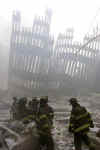 A lot of things have happened in the last five years. Some were good--this nation was unified in an unprecedented way after September 11th, 2001, and the world was with us. Bad things have happened as well, and it is particularly troubling to see the degree to which deeply painful images (like the one to the left) have been used in service of political ideology, especially over the past couple of weeks.
Today is not a day for ideology. It is a day for remembrance. Nearly three thousand people lost their lives five years ago today. Over three thousand children lost a parent. This is a day to pray for them all, and to hope that nothing like that day ever happens again.
There must be a time for reflection upon the events of the past five years, especially those which relate directly to the events of September 11, 2001. We need to think about the course we're on, and where it will get us.
But today is not that time. Today we grieve and pray and hope, trusting that God is holding us all, especially those whose lives were touched more directly by that horrible day. May God bless them and comfort them today.
Wednesday, September 06, 2006
The Message about the Cross is Foolishness!
A couple of recent events have gotten me thinking about the cross.
The first is the reported removal of the two large crosses on our old building, which is in the process of being sold. A Buddhist community is buying it, so, of course, they have taken down the crosses. There were just two left--we took all the ones that weren't nailed down (no very bad pun intended). There was one on the outside of the building, which couldn't be seen most of the summer, because of the trees planted ever-so-close to the building. The other was a really nice one, built to match the altar rail, on the front wall of the sanctuary. Some of my members wanted to take that one down and bring it with us when we moved. I advocated leaving it there, since it was built for the space (and probably wouldn't fit in our storage unit).
Now I feel bad. Very bad--pit of the stomach bad. I wish we'd have figured out how to take it out, and while we're at it, the altar rail too. Why not?
It's probably a moot point, but I really liked that cross, and its architechtural link to the rail at which we knelt to receive the body and blood of Christ. I actually didn't notice the tie-in at first, and thought it was the coolest thing ever when someone pointed it out. (Yes, I am observant, aren't I?) It makes me sad that no one will have the experience of kneeling at that rail before that cross now.
The other thing that has me thinking about crosses is that I went to a play at a church of a denomination I won't name, in a place I also won't name (so as to avoid the impression of picking on either Presbyterians or people who live in Johnson County, since this isn't about either of those things). There was a video screen in the sanctuary in which the play was held, which was obviously operated remotely, because it went down--closed--as the show began. But here's the thing: when it's up, it covers about half of the cross on the wall.
I don't have a "screen thing." I know some people believe screens have no place in worship, and they are welcome to think that. But I think it can be helpful to have the words to hymns projected during worship. It's surely better than singing with your chin on your chest reading from a book in your hand. And when it's done well, it can also be helpful to have well-chosen, thoughtful images projected during the sermon or meditation time.
But I would have to draw the line at a screen which covers the cross, even partially. Were I a member of that church, I would have been part of the contingent of folks (for surely there was such a contingent) who thought that was a bad idea.
There are a lot of worship spaces these days which don't even have crosses. There are a lot of people these days who think that the cross is a grotesque symbol. We've all heard the old saw about how "you wouldn't wear an electric chair on a chain around your neck."
But the salvation of the world was accomplished on the cross. And while that may seem like foolishness, as St. Paul asserted it would almost two thousand years ago--it is actually the height and depth of God's wisdom, as St. Paul also asserted. Yes, I'm liking Paul again today--been doing a lot of that lately.
The cross should be at the center of our worship, and at the center of our lives. Wear it around your neck if you want. More importantly, kneel before it and give thanks to God, who is faithful and just, and who chose to become human in order that we might be saved. That may be foolishness, but I'm pretty grateful for it.
The first is the reported removal of the two large crosses on our old building, which is in the process of being sold. A Buddhist community is buying it, so, of course, they have taken down the crosses. There were just two left--we took all the ones that weren't nailed down (no very bad pun intended). There was one on the outside of the building, which couldn't be seen most of the summer, because of the trees planted ever-so-close to the building. The other was a really nice one, built to match the altar rail, on the front wall of the sanctuary. Some of my members wanted to take that one down and bring it with us when we moved. I advocated leaving it there, since it was built for the space (and probably wouldn't fit in our storage unit).
Now I feel bad. Very bad--pit of the stomach bad. I wish we'd have figured out how to take it out, and while we're at it, the altar rail too. Why not?
It's probably a moot point, but I really liked that cross, and its architechtural link to the rail at which we knelt to receive the body and blood of Christ. I actually didn't notice the tie-in at first, and thought it was the coolest thing ever when someone pointed it out. (Yes, I am observant, aren't I?) It makes me sad that no one will have the experience of kneeling at that rail before that cross now.
The other thing that has me thinking about crosses is that I went to a play at a church of a denomination I won't name, in a place I also won't name (so as to avoid the impression of picking on either Presbyterians or people who live in Johnson County, since this isn't about either of those things). There was a video screen in the sanctuary in which the play was held, which was obviously operated remotely, because it went down--closed--as the show began. But here's the thing: when it's up, it covers about half of the cross on the wall.
I don't have a "screen thing." I know some people believe screens have no place in worship, and they are welcome to think that. But I think it can be helpful to have the words to hymns projected during worship. It's surely better than singing with your chin on your chest reading from a book in your hand. And when it's done well, it can also be helpful to have well-chosen, thoughtful images projected during the sermon or meditation time.
But I would have to draw the line at a screen which covers the cross, even partially. Were I a member of that church, I would have been part of the contingent of folks (for surely there was such a contingent) who thought that was a bad idea.
There are a lot of worship spaces these days which don't even have crosses. There are a lot of people these days who think that the cross is a grotesque symbol. We've all heard the old saw about how "you wouldn't wear an electric chair on a chain around your neck."
But the salvation of the world was accomplished on the cross. And while that may seem like foolishness, as St. Paul asserted it would almost two thousand years ago--it is actually the height and depth of God's wisdom, as St. Paul also asserted. Yes, I'm liking Paul again today--been doing a lot of that lately.
The cross should be at the center of our worship, and at the center of our lives. Wear it around your neck if you want. More importantly, kneel before it and give thanks to God, who is faithful and just, and who chose to become human in order that we might be saved. That may be foolishness, but I'm pretty grateful for it.
Wednesday, August 30, 2006
My Fantasy--Larry Johnson
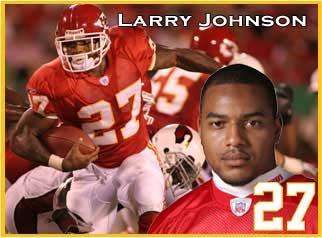 No, I haven't switched teams. I just added one--a Fantasy Football team through nfl.com. Our automated draft was yesterday. And I got Larry John-son. I got Larry John-son.
This is so awesome, because LJ is the #1 fantasy player, and he's a Chief! Not that I needed another reason to root for the Chiefs, who have done everything in the off season that they needed to do, with the possible exception of securing a more solid backup QB behind Trent Green. But that seems less critical (jinx warning) in the Herm Edwards era, when Trent will be handing off (to...oh...Larry John-son!) more than ever. I also have some confidence that Brody Croyle isn't as bad as he looked Saturday night, when he completed one of nine and was mercifully pulled for poor Casey Printers, who keeps having to stand behind the second team line (or run behind, as it were). And, yes, I wish we had Willie Roaf, but there's nothing the Chiefs can do about that. They've made it clear that his locker is still available.
I do hope its a good year for the Chiefs, mainly because I LOVE this team. Almost as much as I love my Wolverines. I also hope they do well because my 14 member fantasy team also includes Lawrence Tynes as backup kicker (behind Adam Vinatieri!) and the Chiefs defense--don't laugh, non-Chiefs fans. They're going to be better. Ty Law, baby, (!) who learned how to pick passes at a little school in Ann Arbor, Michigan. It just all comes around, doesn't it?
Okay, lunch break over. And I will try to write about something besides football now. But I got Larry John-son!
By the way, the fantasy league I'm in is called Go Blue Wolverines. Isn't life great?!
Thursday, August 24, 2006
Go Blue--Nine Days and Counting!
 Michigan football kicks off in nine days...actually, just under nine days, since the game is at 11 a.m. Central Time, and it's just after noon here.
Michigan football!
Hail! to the victors valiant,
Hail! to the conqu'ring heroes,
Hail! Hail! to Michigan,
the leaders and best.
There's another verse, but I'll spare you. Actually, there are a bunch of verses, and this is just the first half of the fight song chorus. But the chorus is the part sung by those of us who sing and pump our arms like crazy people. I can tell you that it's pretty powerful to be in Michigan stadium with well over a hundred thousand dear friends, all singing these words and pumping their arms.
I don't know what it is about Michigan football that captivated me so long ago. We moved from Ann Arbor the day before I turned seven. I didn't go to Michigan; I went to San Francisco State (which had a football team, though most of the students never went to a game). I always thought I'd go to Michigan, but reality set in hard my senior year, when I realized that I had neither the grades nor the money. I could probably have managed the grades, had I stopped feeling sorry for myself for being stuck in California. (pause for laughter) But the money would have been a bit more challenging. So SF State it was, and the decision was honestly a good one.
And through it all, I have been a fan of the Maize and Blue. That fan-dom goes way beyond the outrageously good show the boys put on practically every year. Michigan football is home to me. We moved around when I was a kid. Not as much as some kids, but more than I would have liked. Before starting high school, I had lived in four states. Started four different elementary schools.
Michigan football was a constant, a taste of something familiar brought into my living room every Fall. It was a reminder that some things stay the same, that there is an order in the universe. That good blocking and an effective pass rush can get you a long way.
This may sound crazy, or blasphemous, or both, but I sometimes think that Michigan football was a gift to me from God. There are those who will tell you that my rapt attention and verbal energy during a game approach the level of worship.
No, I don't worship Michigan football. And if I yelled like that in worship, I'd have to turn in my Lutheran Card. But just as the church year kicks into high gear each Fall, the boys in Maize and Blue drop into the living room, in the striped helmets which haven't changed their look since 1938.
Constants are good. Familiar is good. I'm keeping my Lutheran Card, and GO BLUE!
Wednesday, August 23, 2006
Ten Minute Sabbath
Okay, so I'm really not the idle blogger. I haven't posted anything here in a while. A long while actually. But I have written a bunch of devotions which are published on my other blog, tenminutesabbath.blogspot.com.
They're short devotions, each consisting of an opening prayer, a reading, a meditation, and a closing prayer. The readings are from the Bible, and from other places--prayers, readings and meditations from folks like the greatest Buddhist monk, Thich Nhat Hahn; Mohammed; Mother Teresa. I've tried to include a lot of different stuff, and to ask some questions in the meditations to help folks think about their faith and their lives in light of the readings.
Right now the devotions are set up as two "weeks of sabbath." The first week has two devotions for each day, morning and evening. The second week has one devotion for each day. Feel free to do a week of sabbath, or to just do one or two. Or just to look around and see if there's anything you like.
I think they're not bad, and hope that they bring a moment of sabbath into our busy lives.
And I'll try to keep up with this blog, too...
They're short devotions, each consisting of an opening prayer, a reading, a meditation, and a closing prayer. The readings are from the Bible, and from other places--prayers, readings and meditations from folks like the greatest Buddhist monk, Thich Nhat Hahn; Mohammed; Mother Teresa. I've tried to include a lot of different stuff, and to ask some questions in the meditations to help folks think about their faith and their lives in light of the readings.
Right now the devotions are set up as two "weeks of sabbath." The first week has two devotions for each day, morning and evening. The second week has one devotion for each day. Feel free to do a week of sabbath, or to just do one or two. Or just to look around and see if there's anything you like.
I think they're not bad, and hope that they bring a moment of sabbath into our busy lives.
And I'll try to keep up with this blog, too...
Friday, June 30, 2006
I Just Love The Onion
They just have the best stuff! I can't resist them! Here's another one, for the crunchy environmentalist in us all: click me
Thursday, June 29, 2006
Not for the Pious
Okay, if you're secure in your personal piety, and want to read something pretty funny, click above.
If you don't like jokes about salvation (and why not?), DO NOT click above.
If you don't like jokes about salvation (and why not?), DO NOT click above.
So many cords, so little time
Remember the olden days? In your bedroom you'd have a lamp, and maybe a stereo (though some of us had a battery-operated transistor). Maybe you even had a stereo and a clock radio. Still, those would pretty much be all the "corded things" you had. There would be empty plugs, just waiting for a blow dryer, or a fan.
Today I'm sitting in my spare bedroom/office, and realizing that if these cords rise up against me, I'm a goner. There are two different power strips in here, and every plug except the one we just uncovered (used to be behind the bed) is chock full. I've got a couple of printers, a stereo, a monitor, a processor, a Road Runner box, and a desk lamp plugged in under my feet. There's a fan, a phone, the charger for the PDA, and something-else-I'd-have-to-follow-the-cord plugged in behind me. Into the computer box run cords for most of the aforementioned items, plus the connector cables for the camera, the PDA, the MP3 and whatever else can be reduced to letters and numbers and plugged into the computer.
There's no point to this rant, really. Just a bit of nostalgia for a simpler time, coupled (ironically) with a real love for all of these gadgets.
Today I'm sitting in my spare bedroom/office, and realizing that if these cords rise up against me, I'm a goner. There are two different power strips in here, and every plug except the one we just uncovered (used to be behind the bed) is chock full. I've got a couple of printers, a stereo, a monitor, a processor, a Road Runner box, and a desk lamp plugged in under my feet. There's a fan, a phone, the charger for the PDA, and something-else-I'd-have-to-follow-the-cord plugged in behind me. Into the computer box run cords for most of the aforementioned items, plus the connector cables for the camera, the PDA, the MP3 and whatever else can be reduced to letters and numbers and plugged into the computer.
There's no point to this rant, really. Just a bit of nostalgia for a simpler time, coupled (ironically) with a real love for all of these gadgets.
Thursday, June 08, 2006
Pyrrhic Victories
I love the Human Rights Campaign. I really do. I love the little blue squares with the little yellow equal signs that keep conservatives from knowing what you're all about. HRC has enabled a whole generation of people to be personally supportive without putting themselves in any danger. (Warning: the previous is three parts true, one part sarcasm.)
Apologies to those who don't know what I'm talking about. The Human Rights Campaign is a premier national gay rights organization, which has taken as its symbol the equal sign, yellow on a blue square. People put these symbols on their cars, mainly, but you'll find them on hats and shirts as well. You may have seen them, and wondered what they're all about. (Yeah, that's my problem in a nutshell.) HRC is on the forefront of the campaign for human rights for gay, lesbian, bisexual and transgender folks. They really do a lot of great work. No parts sarcasm.
HRC is claiming victory today over the defeat of the Federal Marriage Amendment.
I understand this. Really. When you're not getting a lot of major victories, you've got to take what you can get.
But the defeat of the FMA isn't a victory, any more than it's a victory for me if my dogs to go out when I open the back door. The dogs go out because they like (and need) the backyard. If they stopped going out, I'd stop opening the back door.
Everyone--from Howard Dean to James Dobson--knew that the FMA wouldn't pass. Nearly every news story about it included some caveat about the unlikelihood of a two-thirds vote, or even the sixty votes needed to keep the legislation going this time around. Nearly every news story explained, in patronizing detail, that this was just a political move to shore up the conservative base in an election year.
One part of me wishes it had just passed. Three parts of me are still glad it didn't, of course, but I'm really kind of sick of the two-year cyclical roller coaster.
Since the FMA failed again, despite the president's oh-so-lukewarm support, the back door is still open. And in two years, when we need to choose a new president, the topic of the day will once again not be war, peace, feeding the hungry, abuse of prisoners worldwide, why Johnny can't read, or any of the other really important, pressing matters facing this nation and the world. It will be the dire threat that lesbian and gay people pose to the oh-so-thriving institution of marriage.
Every two years, we get to be a major issue, because our elected officials like (and need) diversions from the mess we're in as a country.
Missouri struck down its gay sodomy law yesterday. This means that my friend and council president Lisa cannot be considered "lacking in moral character" simply because she is a lesbian. That is the argument that the Department of Social Services used to deny Lisa a foster parent license, despite the fact that her education and her entire career have been devoted to caring for kids in need.
Lisa took a stand, very publicly, which surely wasn't easy for someone who doesn't seek the limelight. But she has helped remove the sanctioned bigotry of Missouri state law. Because of her courage, others may not have to defend their "lifestyles" before the courts of this state.
Now that's a victory.
Apologies to those who don't know what I'm talking about. The Human Rights Campaign is a premier national gay rights organization, which has taken as its symbol the equal sign, yellow on a blue square. People put these symbols on their cars, mainly, but you'll find them on hats and shirts as well. You may have seen them, and wondered what they're all about. (Yeah, that's my problem in a nutshell.) HRC is on the forefront of the campaign for human rights for gay, lesbian, bisexual and transgender folks. They really do a lot of great work. No parts sarcasm.
HRC is claiming victory today over the defeat of the Federal Marriage Amendment.
I understand this. Really. When you're not getting a lot of major victories, you've got to take what you can get.
But the defeat of the FMA isn't a victory, any more than it's a victory for me if my dogs to go out when I open the back door. The dogs go out because they like (and need) the backyard. If they stopped going out, I'd stop opening the back door.
Everyone--from Howard Dean to James Dobson--knew that the FMA wouldn't pass. Nearly every news story about it included some caveat about the unlikelihood of a two-thirds vote, or even the sixty votes needed to keep the legislation going this time around. Nearly every news story explained, in patronizing detail, that this was just a political move to shore up the conservative base in an election year.
One part of me wishes it had just passed. Three parts of me are still glad it didn't, of course, but I'm really kind of sick of the two-year cyclical roller coaster.
Since the FMA failed again, despite the president's oh-so-lukewarm support, the back door is still open. And in two years, when we need to choose a new president, the topic of the day will once again not be war, peace, feeding the hungry, abuse of prisoners worldwide, why Johnny can't read, or any of the other really important, pressing matters facing this nation and the world. It will be the dire threat that lesbian and gay people pose to the oh-so-thriving institution of marriage.
Every two years, we get to be a major issue, because our elected officials like (and need) diversions from the mess we're in as a country.
Missouri struck down its gay sodomy law yesterday. This means that my friend and council president Lisa cannot be considered "lacking in moral character" simply because she is a lesbian. That is the argument that the Department of Social Services used to deny Lisa a foster parent license, despite the fact that her education and her entire career have been devoted to caring for kids in need.
Lisa took a stand, very publicly, which surely wasn't easy for someone who doesn't seek the limelight. But she has helped remove the sanctioned bigotry of Missouri state law. Because of her courage, others may not have to defend their "lifestyles" before the courts of this state.
Now that's a victory.
Tuesday, May 30, 2006
Self Care 101

We got away this weekend--packed up the van and the dogs and a lot of junky food (never shop for vacation food when hungry), and drove up to spend the night with our friends Serena and Anna at their place up at Lake Viking.
It was great.
We were able to get away because we were both off on Monday. It's kind of tricky when one of you is off Saturday and Sunday, and one works Sunday morning. But it's more possible to get away than we usually think. You just have to do it.
We've already decided we're going again in two weeks, even though we've got other stuff going that weekend. We're just going to do it.
Might be learning something in my old age.
Wednesday, May 17, 2006
Choices
I need to quit my job. The one that's my "job," and not my "career." I work three shifts a week, 15-20 hours or so, waiting tables at a fine seafood restaurant in Leawood, Kansas. I have that job because I'm only 3/4 time at my career job.
I need to quit the second job, because it eats up energy and time I would like to put toward my "real job," being the pastor of Abiding Peace Lutheran Church.
I need to quit that job because I am the entire staff of Abiding Peace, which means if we're going to grow, it's up to me. Yes, that's bad ecclesiology--the growth of the church is up to the whole community, right? But ecclesiology and reality are often downright hostile to one another. (Just google "Reformation" for evidence of this.) The truth is, the congregation is looking to me to grow this church, and whether I like it or not is really beside the point.
So I need to quit that second job. It's hard, though, because there's also all this stuff I want.
I want a laptop. I want a new desk chair. I want to go on vacation, somewhere cool. I want to continue to download the internet at lightening speed by paying forty dollars a month to Time Warner Cable.
Because I'm three-quarters time at church and still pay $450 a month for the privilege of having borrowed a seminary education, something will have to go in order for me to quit my second job. One of those things I consider essential...those things that are really choices, but which America teaches us we deserve. I deserve a cell phone and a laptop and Road Runner high speed internet. I deserve them. Plus, I need them to do my job (the real one) better. That's my favorite rationalization of all.
I don't know yet what I'll do. It's a hard choice. If you are reading this, your wisdom is sought. Prayers are good too. Just as a general rule.
I need to quit the second job, because it eats up energy and time I would like to put toward my "real job," being the pastor of Abiding Peace Lutheran Church.
I need to quit that job because I am the entire staff of Abiding Peace, which means if we're going to grow, it's up to me. Yes, that's bad ecclesiology--the growth of the church is up to the whole community, right? But ecclesiology and reality are often downright hostile to one another. (Just google "Reformation" for evidence of this.) The truth is, the congregation is looking to me to grow this church, and whether I like it or not is really beside the point.
So I need to quit that second job. It's hard, though, because there's also all this stuff I want.
I want a laptop. I want a new desk chair. I want to go on vacation, somewhere cool. I want to continue to download the internet at lightening speed by paying forty dollars a month to Time Warner Cable.
Because I'm three-quarters time at church and still pay $450 a month for the privilege of having borrowed a seminary education, something will have to go in order for me to quit my second job. One of those things I consider essential...those things that are really choices, but which America teaches us we deserve. I deserve a cell phone and a laptop and Road Runner high speed internet. I deserve them. Plus, I need them to do my job (the real one) better. That's my favorite rationalization of all.
I don't know yet what I'll do. It's a hard choice. If you are reading this, your wisdom is sought. Prayers are good too. Just as a general rule.
Friday, May 12, 2006
Every Movement Needs an Enemy
I was listening to Fresh Air (with Terry Gross) yesterday while driving around charging my car battery (another story) . Terry's guest was Michelle Goldberg, who has written a book called Kingdom Coming--The Rise of Christian Nationalism. It was a fascinating interview; you can listen by clicking the title above. Once you get to that page, just click on the "Listen" icon.
Goldberg's book explores the concerted effort on the part of the Christian Right to become a force in American political life. Actually, "become a force" isn't quite right--where the movement is most organized, the goal is domination. Some have said that quite openly. It's pretty scary.
Eventually, of course, the conversation rolled around to the very large anti-gay plank in the Right's platform, and Terry asked why gay and lesbian people have become such a visible target of this movement. Michelle Goldberg explained that the right has formed alliances with many of its former adversaries (African-American evangelicals, Jews). Then she said "Every movement needs an enemy."
So we are the convenient enemy of the Religious Right. And that's working out rather well for them. It certainly helped reelect our esteemed president, especially in states like Ohio and Missouri which had gay marriage initiatives on their ballots.
I got to thinking about this idea that gay and lesbian people are a good enemy for the religious right. If we're going to serve in this capacity, explained Goldberg, it is important that gay and lesbian people be seen as the enemy of all that is beloved of the Christian Right. So gay people are painted as not just wanting "special rights" like health insurance, the right to visit a loved one in the hospital, and legal recognition of our relationships. According to people like D. James Kennedy and Jerry Falwell, we're trying to destroy the institution of marriage. (You know, the one we keep begging crumbs from--logic is much less important than fierce rhetoric here.) And we are absolutely anti-Christian. We're behind the War on Christmas and the War on Christians. (We're only nominally responsible for the War on Terror, thankfully.)
Anyway, here's the part I think is really interesting. My premise, if you will. No wonder conservatives in the church get so unbelievably bent about gay people in the church. It wrecks the fundaments of the gays-are-out-to-destroy-Christianity argument (which is deliciously compelling) if we are trying to worship and (egads!) get ordained.
No wonder they are so mad. These crazy queers who insist on staying in the church are just ruining their social studies project.
That makes my day. Perhaps I am actually twisted.
Goldberg's book explores the concerted effort on the part of the Christian Right to become a force in American political life. Actually, "become a force" isn't quite right--where the movement is most organized, the goal is domination. Some have said that quite openly. It's pretty scary.
Eventually, of course, the conversation rolled around to the very large anti-gay plank in the Right's platform, and Terry asked why gay and lesbian people have become such a visible target of this movement. Michelle Goldberg explained that the right has formed alliances with many of its former adversaries (African-American evangelicals, Jews). Then she said "Every movement needs an enemy."
So we are the convenient enemy of the Religious Right. And that's working out rather well for them. It certainly helped reelect our esteemed president, especially in states like Ohio and Missouri which had gay marriage initiatives on their ballots.
I got to thinking about this idea that gay and lesbian people are a good enemy for the religious right. If we're going to serve in this capacity, explained Goldberg, it is important that gay and lesbian people be seen as the enemy of all that is beloved of the Christian Right. So gay people are painted as not just wanting "special rights" like health insurance, the right to visit a loved one in the hospital, and legal recognition of our relationships. According to people like D. James Kennedy and Jerry Falwell, we're trying to destroy the institution of marriage. (You know, the one we keep begging crumbs from--logic is much less important than fierce rhetoric here.) And we are absolutely anti-Christian. We're behind the War on Christmas and the War on Christians. (We're only nominally responsible for the War on Terror, thankfully.)
Anyway, here's the part I think is really interesting. My premise, if you will. No wonder conservatives in the church get so unbelievably bent about gay people in the church. It wrecks the fundaments of the gays-are-out-to-destroy-Christianity argument (which is deliciously compelling) if we are trying to worship and (egads!) get ordained.
No wonder they are so mad. These crazy queers who insist on staying in the church are just ruining their social studies project.
That makes my day. Perhaps I am actually twisted.
Wednesday, May 10, 2006
They will know we are Christians...
So yesterday I said to a friend, rather flippantly, that gay people are seldom persecuted these days, at least not openly. For the most part, we're allowed to live our lives, and only have to endure hatefulness from the people who write letters to the editor and resolutions for the Synod Assembly.
And then today I heard from another friend that an incredibly talented music director in town was serving his last Sunday this week at a local Catholic parish. (Sorry to be circumspect; I don't know how public he wants this story to be, so I'm erring on the side of circumspect.) The gentleman in question has been forced out by a cabal of hateful folks in the parish, who have subjected him to letters, notes, and even written messages on his belongings. One of the notes simply said "Leave, Fag!"
Ah, the love of a Christian community.
I almost wish he could stay another week, so that the congregation could hear the words of the lectionary gospel of the day, St. John, chapter 15--“This is my commandment, that you love one another as I have loved you"--as they bid farewell to the best director in town.
Is it just me, or is hatefulness becoming a default mode in our public discourse? People don't even seem to hide their hatefulness any more--they just come right out with it. There's another post here, but I wanted this story to stand on its own. It is a story of needless loss, and a reminder that the church cannot simply "allow everyone their opinions." Some "opinions" are wrong. If we don't have the courage to say that, then the hatefulness will escalate, and the Body of Christ will lose more blood.
And then today I heard from another friend that an incredibly talented music director in town was serving his last Sunday this week at a local Catholic parish. (Sorry to be circumspect; I don't know how public he wants this story to be, so I'm erring on the side of circumspect.) The gentleman in question has been forced out by a cabal of hateful folks in the parish, who have subjected him to letters, notes, and even written messages on his belongings. One of the notes simply said "Leave, Fag!"
Ah, the love of a Christian community.
I almost wish he could stay another week, so that the congregation could hear the words of the lectionary gospel of the day, St. John, chapter 15--“This is my commandment, that you love one another as I have loved you"--as they bid farewell to the best director in town.
Is it just me, or is hatefulness becoming a default mode in our public discourse? People don't even seem to hide their hatefulness any more--they just come right out with it. There's another post here, but I wanted this story to stand on its own. It is a story of needless loss, and a reminder that the church cannot simply "allow everyone their opinions." Some "opinions" are wrong. If we don't have the courage to say that, then the hatefulness will escalate, and the Body of Christ will lose more blood.
Subscribe to:
Comments (Atom)